Zygomatic & Remote Anchorage Implants in Indiana
Dental Expertise in Indianapolis
.svg)
When "You Don't Have Enough Bone" Isn't the End of the Road
If another dentist has told you there's not enough bone for implants, this is the page for you. Zygomatic and remote anchorage implants are built for exactly that situation: instead of relying on jawbone that's worn away, they anchor into the dense cheekbone and other stable bone sites that hold up even after years of loss. That means many people who were turned away from traditional implants can still get a full, fixed set of teeth.
Dr. Matthew Fraiz, Dr. Brian Fraiz, and the team handle complex implant cases like this across the greater Indianapolis area. Because these implants often skip the need for bone grafting first, the whole process usually runs about 4 to 6 months from consultation to final teeth, rather than the 12 to 18 months grafting can add.
If you're ready to look past "not enough bone" and see what's actually possible for you, we'd love to talk it through. Reach whichever office is most convenient:
- Indianapolis: 9333 N Meridian St, Suite #225 - (317) 872-3465
- Greenwood: 997 E County Line Rd, Suite L - (317) 865-1193
- Shelbyville: 122 Lee Blvd - (317) 398-6399
Quick Takeaways
- These implants anchor into the cheekbone or other stable sites, so severe jawbone loss doesn't automatically rule you out.
- Bone grafting is often unnecessary, which usually shortens treatment time considerably.
- This is a specialized surgical procedure, so ask any provider how often they perform it and who's doing the surgery.
- The goal is a full arch of fixed teeth, and most people leave surgery day with a temporary set already in place.
- The next step is a consultation with 3D imaging, which gives you a clear yes or no either way.
How the Zygomatic & Remote Anchorage Implants Procedure Works
We treat zygomatic implants like the specialized surgery they are, so nothing gets scheduled until we've sat down with you and talked through the whole picture. Here's how it generally goes:
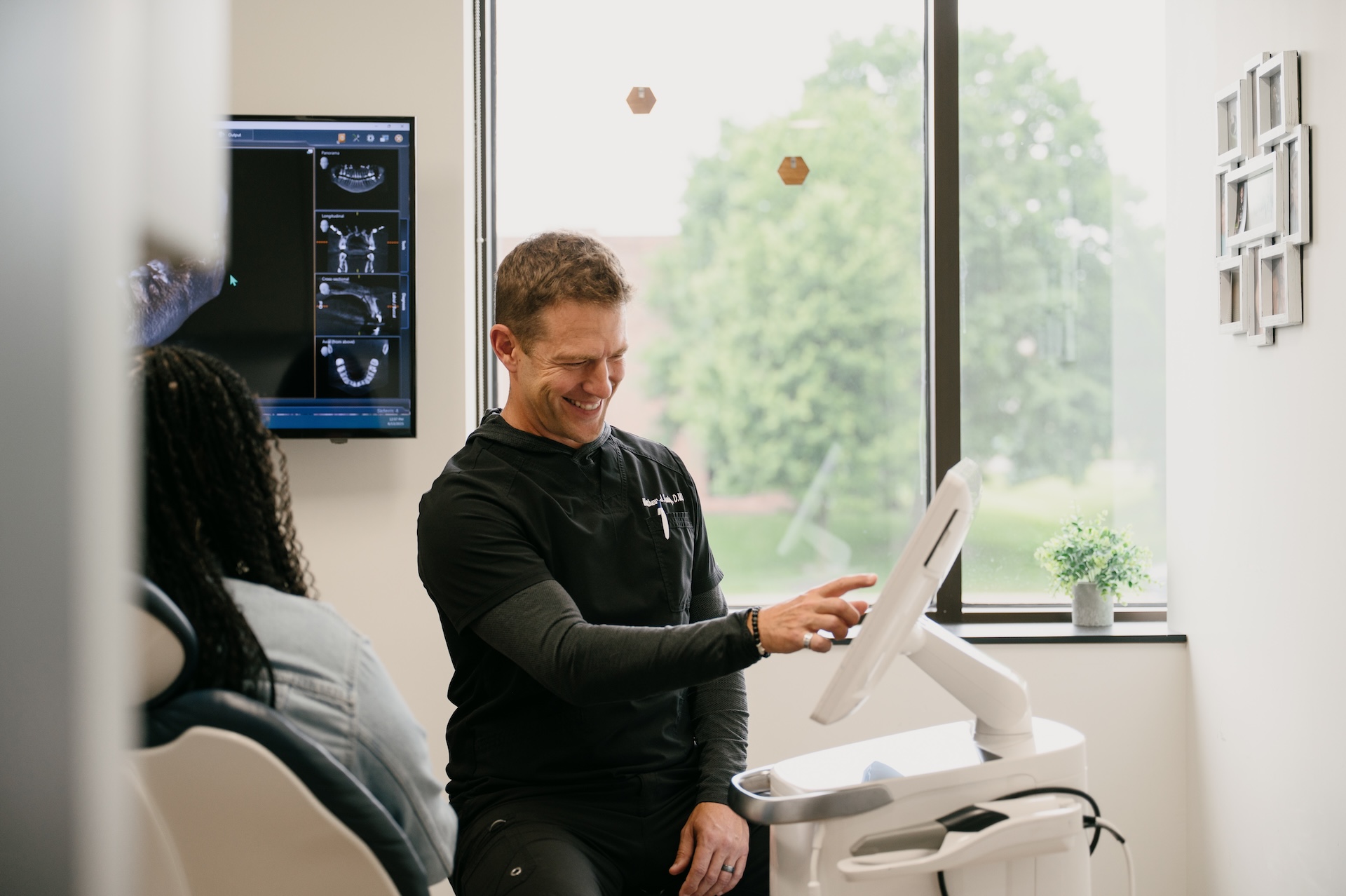
- Consultation and imaging. We look at your mouth, take a 3D CBCT scan to map your bone and anatomy in detail, and talk about what you want your smile to do for you. This is the same evaluation process used for our dental implant cases, with additional mapping specific to zygomatic placement.
- Planning it all out. We map the surgery, coordinate scheduling, and handle the details in-house, so you're not bouncing between offices.
- Placing the implants. The implants are placed with IV sedation or general anesthesia so you're comfortable throughout the procedure. In most cases, you leave the same day with a temporary set of teeth.
- Healing and final teeth. As the implants fuse with the bone, we keep an eye on your healing and then fit your permanent restoration.
Every step stays under one roof with one team, which keeps things clear and cuts out the shuffle between specialists that these cases usually involve elsewhere.
Why People Choose This Route
For someone who's been told standard implants aren't an option, the appeal is straightforward: you get back to a full, working smile without a long detour first. The concrete benefits include:
- No graft in most cases. Because the implants use bone that's still solid, you often skip the grafting surgery and the many months of healing that come with it.
- Teeth that stay put. This is a fixed restoration, not a removable denture, so there's no slipping while you eat or talk.
- Fixed function right away. You have a full, working smile throughout healing rather than going without teeth.
- Real chewing power back. Anchoring into dense bone gives you the stability to eat the foods you'd given up on.
- A long-term answer. With good care, these implants are designed to last for years, with success comparable to traditional implants.
Are You a Candidate For Zygomatic & Remote Anchorage Implants?
Zygomatic and remote anchorage implants are made for the situations where ordinary implant placement won't hold. You may be a good fit if you're dealing with:
- Severe bone loss in the upper jaw from long-term tooth loss or gum disease
- A previous implant that failed, especially in the upper arch
- Years of denture wear that has worn the bone down significantly
- A recommendation from somewhere else that you need major bone grafting first
In some cases, remote anchorage approaches can help with serious bone loss in the lower jaw too, not only the upper.
This won't be the right answer for everyone, though. Active gum infection, certain health conditions, or a case that's better solved another way can all point elsewhere, and if a more conventional implant or an All-on-X plan fits you better, we'll say so. That's why we don't recommend a path until we've done a clinical exam and a detailed 3D CBCT scan of your bone and anatomy.
Timeline and Recovery: What to Realistically Expect
This surgery is more involved than a single standard dental implant, so it helps to plan your calendar around it. Most people set aside 5 to 7 days away from work and busy obligations for the early healing stretch, and get back to full activity within about 2 to 3 weeks.
- Consultation, 3D imaging, and planning: about 1 to 2 weeks
- Surgery and your temporary teeth: the same day
- Healing while the implants fuse to bone: about 3 to 4 months
- Final teeth fitted and fine-tuned: 2 to 3 visits over 2 to 4 weeks
Most people care appreciate the fact that you won't be walking around without teeth during the process. A temporary set is placed the day of surgery, so you keep both function and appearance while everything heals. Longer term, these implants do best with regular maintenance visits every 3 to 6 months, and we lay that out at your consultation so nothing surprises you later.
How to Prepare and How to Care for Your New Teeth
Before surgery, we'll go over your health history and any medications, and we'll ask you to line up a ride home since you'll have had either IV sedation, or general anesthesia. It's worth stocking the fridge with soft foods ahead of time and clearing your schedule for that first recovery week.
Afterward, care is more manageable than most people expect. You'll mainly need to:
- Stick to soft foods early on and ease back toward your normal diet as we advise.
- Keep the area clean with the gentle routine we walk you through, and follow any rinse instructions.
- Brush and clean around your fixed teeth daily, just like natural teeth.
- Come in for a maintenance visit every 3 to 6 months so we can check the implants and keep everything healthy.
Cost, Financing, and Insurance For Zygomatic & Remote Anchorage Implants
This is a meaningful investment, and you deserve straight numbers before you commit to anything. What shapes the cost:
- How many implants your case calls for, often 4 to 6 per arch
- How complex your bone anatomy and surgical approach are
- The type of final restoration, such as an acrylic hybrid or zirconia
- Whether any prep work is needed beforehand
Because every case differs, we don't post a flat price; we review the full cost with you during the consultation, once we can see your imaging and know exactly what your case involves.
If you carry dental insurance, we'll verify your benefits ahead of time and show you a clear breakdown of what your plan covers versus what's yours to pay.
Why Patients Choose Indy Dental Health for This
Zygomatic implants are a specialized procedure, and not every office is set up to handle them well. What makes a real difference here is having surgical expertise, advanced imaging, and restoration capability all under one roof, so nothing gets handed off and nothing falls through the cracks.
A few things that are specific to how we work:
- Every phase of treatment, from your first scan through your final restoration, is handled by our team with no outside referrals
- Dr. Brian Fraiz brings focused training in All-on-X and full-arch surgery to cases that many practices simply refer out
- Dr. Matthew Fraiz completed post-graduate training in IV sedation, which means surgical comfort and case complexity can be managed by the same experienced hands
- Cone beam 3D imaging and in-house 3D printing let us plan and build your case with a level of precision that general offices typically can't match
- With offices in Indianapolis, Greenwood, and Shelbyville, follow-up visits and ongoing care fit into your schedule without requiring a long drive that's out of your way
Frequently Asked Questions
How are zygomatic implants different from regular implants?
Standard implants anchor into the jawbone. Zygomatic implants are longer, roughly 30 to 52mm versus 8 to 16mm for standard ones, and they anchor into the cheekbone, called the zygoma. That's what makes them work when the upper jaw no longer has enough bone for conventional implants.
Will I need a bone graft first?
Usually not, and that's a big reason people choose this route. Since the implants bypass the jawbone, grafting is typically unnecessary, which spares you months of extra healing and additional surgery.
How long do they last?
They're designed as a long-term solution, with success rates comparable to traditional implants over 10 or more years. Your result depends on your oral hygiene, overall health, and staying on top of your routine dental care visits.
Can I get teeth the same day?
In most cases, yes. A temporary restoration usually goes in the day of surgery, so you leave with working teeth. Your final set is typically fitted about 3 to 4 months later, once you've healed.
What if I've already had an implant fail?
A prior failure doesn't rule you out. These implants were developed for exactly these tougher cases, including previous failures. The 3D scan and exam tell us whether your anatomy is a good fit.
Is this procedure safe if I have dental anxiety?
Yes. The surgery is done under either IV sedation or general anesthesia, so you're comfortable throughout, and Dr. Matthew Fraiz has post-graduate training focused on IV sedation.
Ready to Find Out If This Is Right for You?
A consultation gives you a real conversation, answers to the questions you've been sitting with, and a clear sense of what actually makes sense for your situation. Reach whichever office is easiest for you:
- Indianapolis: 9333 N Meridian St, Suite #225, Indianapolis, IN 46260 - (317) 872-3465
- Shelbyville: 122 Lee Blvd, Shelbyville, IN 46176 - (317) 398-6399
- Greenwood: 997 E County Line Rd, Suite L, Greenwood, IN 46143 - (317) 865-1193
Whenever you're ready, we're here.
.jpg)
convenient
We invite you to enjoy trusted professionals, personalized treatment, and a great dental experience with three convenient locations to fit your life.

We can’t wait meet you
Request an appointment online to set up your first visit. We’ll be in touch soon.
schedule Appointment